
New Start has special clinics in several towns where we only do medical circumcision of boys and men aged 15 years and older. Our staff are highly experienced, our clinics are hygienic and the service is offered free of charge.The entire process of circumcision – which includes an information session, HIV counselling and testing, a general health check and the actual circumcision – is completed within about an hour and half to two hours. All our patients are discharged on the same day that the circumcision is done and usually go back to school or work the next day.
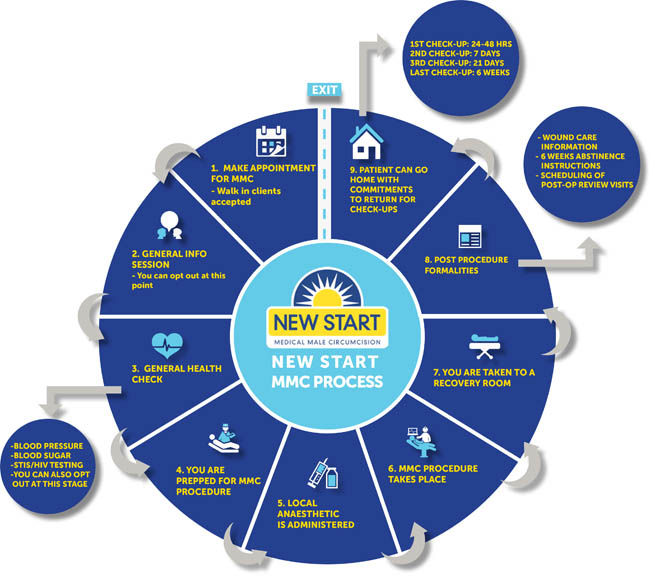
If you are under 18 years you will need consent from your parents before you access New Start MMC services. We do careful follow-up checks after the procedure. The first check-up is done 24-48 hrs after, second check-up is done 7 days after, then 21 days after and the last check-up is done 6 weeks after the circumcision to make sure that the cut is healing properly. This is one of the most important aspects of our service. If there are complications we are able to pick them up early and treat them.
Medical male circumcision (known as MMC, for short) has been proved to reduce the risk of HIV-negative men becoming infected with HIV, helps to prevent other STIs and reduces the incidence of cervical cancer in women. Our MMC Centres form part of a broader New Start programme to prevent HIV and build healthier communities.
What does medical male circumcision involve?
Medical male circumcision – known as MMC, for short – is the surgical removal of the foreskin from the penis. During MMC the entire foreskin is removed so that head of the penis is completely free of any covering skin.
What are the benefits of MMC?
Scientific studies have shown that MMC reduces the risk of an HIV-negative man becoming infected with HIV. It does not offer perfect protection against HIV, but it reduces the chances of infection by 60%. MMC also reduces the risk of genital ulcers and other STIs. In addition, a circumcised penis is easier to keep clean and often results in better hygiene.
Does the female partner of a circumcised man benefit in any way?
Yes, she does. Women with circumcised partners are less likely to contract cancer of the cervix and women who have only ever had sex with circumcised partners have been shown to have a lower rate of HIV.
The New Start programme, was launched in 2004 and operates in areas of Free State, Gauteng, KwaZulu-Natal and Mpumalanga. It offers quality HIV counselling and testing (HCT) services as well as medical male circumcision (MMC) services. Our approach to HCT is innovative and includes pro-active population-based testing for entire neighbourhoods. New Start services are continually marketed in the areas where they operate through teams of community workers.
In addition, if you remain free of HIV and other STIs, this also protects your partner.
However, MMC does not provide protection to either partner during anal sex.
Can MMC prevent an HIV-positive man from infecting his partner?
No, if an HIV-positive man undergoes circumcision this does not prevent him frominfecting his partner in the future.
New Start offers MMC to healthy HIV-positive men, although we are not sure what the specific benefitsare because no studies have yet been done on MMC and HIV-positive men. Men who are HIV-positive should expect a longer healing period after MMC. They should also be aware that there is an increased risk that they will infect their partners with HIV if they have unprotected sex during the healing period.
What are the risks of MMC?
MMC is a form of surgery and all surgery involves some risk. However, the fact that MMC is carried out in sterile conditions by trained medical staff means that the risk is kept very low.
New Start only uses local anaesthetic during MMC. By avoiding a general anaesthetic we also make the procedure safer. A local anaesthetic means that you are awake throughout the surgery but you cannot feel anything in your penis because it has been injected with anaesthetic.
The most common risks occur in the days after the circumcision has been completed and they include pain, bleeding, swelling, infection and a poor reaction to the medicine provided to prevent pain. At New Start clinics we explain the signs of complications to all the boys and men we circumcise. This means they can recognise possible problems and get help early. We also strongly advise all our clients to avoid sex and masturbation for at least six weeks, because returning to sexual activity too early is a major reason for complications.
Can any male undergo MMC?
MMC can be performed at any age on any male who is in good health. New Start only offers services to teenagers aged 12 years and older as well as adult men. However, government health services and private doctors perform circumcisions on babies and boys under the age of 15 years.Babies who are circumcised in the first six weeks of life usually heal very quickly. Because children roughly between the ages of a year and 12 yearscannot be relied on to remain still during surgery, a general anaesthetic may be used for this age group.
Is it still necessary to use a condom if you have been circumcised?
Yes, condom use must be continued after circumcision if you want to be sure you are protected against HIV. Remember, MMC only reduces your chances of getting HIV by 60%. This means there is still quite a high risk of infection. So condoms should still be your main method of HIV prevention. MMC means that when condoms burst, or spill, or if you occasionally forget them, you have back-up protection.
How long does it take to recover from MMC?
For two or three days after MMC it is normal to have a bit of soreness. This can be dealt with by taking pain tablets. It is usually possible to return to school or work one or two days after undergoing MMC.
After that most men are almost pain-free. But it takes about six weeks for the wound to be completely. It is very important to avoid having sex or masturbating during this six-week period. Failure to do so could cause painful complications.
Is it best to get circumcised in winter?
It makes no difference what time of year you go for MMC. When we use the medical method, circumcision is equally safe in winter and summer. The wound takes the same time to heal regardless of the weather.
What is the difference between MMC and traditional circumcision?
Organisations that provide MMC do so because of the health benefits of circumcision, mainly in terms of reducing HIV infections. The service is focused on the health of the individual and therefore good standards of hygiene are followed, pain is reduced through anaesthesia and the proper use of painkillers, and the procedure is only done if the individual is in good health. We perform MMC for men of all cultures and faiths. We respect the fact that circumcision has cultural and religious meaning for many people, but we do not involve ourselves in this aspect.
Traditional circumcision is an important part of an extended ceremony that marks the journey from boyhood to manhood in many South African cultures. The main purpose is to be sure that traditionscontinue to live by passing them on to each generation of males as they become adults. Knowledge of the health risks of circumcision – such as infection and bleeding – varies among traditional practitioners. Some traditional practitioners perform the circumcision hygienically and take measures to prevent infection of the wound, while others are less knowledgeable. It is important to select a traditional practitioner who has a good reputation for returning young men in good health after initiation.
It is also important to note that HIV can be transmitted during traditional circumcision if the practitioner fails to ensure that a new blade or sterile instrument is used for every young man. If an HIV-positive man is circumcised before an HIV-negative man, and the same blade is used without cleaning it thoroughly, the second man could become infected. Many traditional practitioners are aware of this risk and take the necessary steps to ensure they do not infect men during initiation.
Is MMC better than traditional circumcision when it comes to preventing HIV?
If the entire foreskin is removed during traditional circumcision (and clean instruments are used) then traditional circumcision will prevent HIV in exactly the same way as medical circumcision. Complete circumcision reduces the risk of getting HIV, no matter if it is done in a hospital or in the bush
However, sometimes only part of the foreskin is removed during traditional circumcision. In such cases, the risk of HIV infection remains high. It is possible to have MMC at a later stage in order to remove the remaining foreskin.
What if I want MMC but my parents want traditional circumcision for me?
New Start counsellors and community workers are available to meet with young men and their families to discuss matters relating to circumcision. We believe it is best to try to solve these kinds of family problems by talking and sometimes an outsider can make it easier for family members to talk to each other.
The legal position is as follows:
But families need to be able to live together and you need to decide how your family would react if you insisted on using your legal right to have a circumcision or to avoid circumcision. Sometimes it is a better option to involve a respected friend or relative or a counsellor to help the family discuss matters and come to a solution.
All New Start HCT services are run directly by New Start or by one of our NGO partners. Additional services are also offered along with HCT, such as taking samples for TB testing, testing the CD4 levels of people who test HIV-positive and helping you get the help you require from other health clinics and social services.
| Gauteng | |
|
Kula Ndoda: Soweto |
Chris Hani Baragwanath Hospital
Landline: 011 933 0409 |
|
Tsakane, Ekurhuleni |
Tsakane Old Clinic
Cell number: 083 496 6243 |
| KwaZulu-Natal | |
|
East Boom Clinic: Pietermaritzburg |
Boom Street Community Health Centre 541 Boom Street
Landline: 033 342 2253 |
|
Siyaphila Clinic: |
304 Bulwer street, Pietermaritzburg
Landline: 033 342 2253 |
|
Umlazi |
Ithala Centre
Landline: 031 906 6022 |
| Mpumalanga | |
|
Witbank |
Witbank General Hospital grounds,
Cell number: 083 603 3529 |
| Free State | |
|
Bloemfontein |
Pelonomi Hospital
Landline: 081 771 7581 |