HIV counselling and testing for individuals, couples and families
New Start provides HIV counselling and testing services which are an entry point to combination prevention services that include CD4 count testing, sputum sample collection for TB, referrals to New Start’s medical male circumcision service and to a range of health and social services, as required by the individual or family. Our services are designed to encourage more South Africans to undergo testing by bringing the services to the communities that we serve. We provide confidential and quality services to all
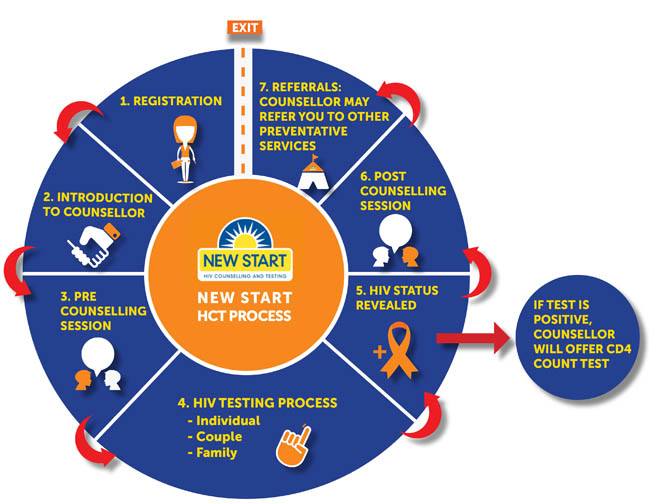
What to expect when New Start does your HIV test:
New Start offers different kinds of HIV counselling and testing to suit the special circumstances of the people we provide services to.
We offer the standard HCT service where individuals come to our testing centres to be counselled in private and take a test to find out their HIV status.
We also provide HCT for couples, where two people in a relationship come together to get tested, share their results and discuss their results with the assistance of a counsellor.
Finally, we provide testing in the privacy of the home for several members of the same family. In this situation we may have parents and their teenage or adult children undergoing testing at the same time. Our counsellors encourage them to share their results in a spirit of openness and support.
You can take an HIV test when you see our mobile testing tents pitched in your area. You should also know that our counsellors go door-to-door offering testing to you (and your family members) in your home.
Frequently asked questions on HIV testing
How do I know if I need to take an HIV test?
We have a very high rate of HIV in South Africa and, because HIV is mostly transmitted during sexual intercourse, all sexually active people in our country should do a regular test for HIV.
There are also situations when testing is especially important:
- If you have been raped, you should be tested as soon as possible for HIV. If you are HIV-negative you should immediately be given ARV medication to reduce the chances of you becoming infected with HIV as a result of the rape.
- If you are pregnant or planning your pregnancy, you need to know your HIV status. If you are HIV-positive it is possible to take ARV medicine from early in your pregnancy to prevent your baby being infected.
What good can an HIV test do? If I'm positive, nothing can change that.
It's true - you can't change your HIV status once you're HIV positive. But you can do the right things to look after your health if you know your status. And you can protect your loved ones from infection.
If you are HIV-positive, you need to take extra-special care of your health. This includes beginning ARV treatment at the right time and remaining on treatment for the rest of your life. It also includes eating healthy foods, getting enough rest, and avoiding heavy use of alcohol - as well as getting early treatment for any illnesses you experience.Provided you take care of yourself, you should live a long life and be able to work and enjoy family life.
Knowing that you are HIV-positive also puts you in a position to protect your sexual partner from infection and to ensure that the virus is not passed on to any children you may have in future. South Africa as a whole can benefit from the responsible actions of HIV-positive people who understand their power to prevent the spread of the virus.
What kinds of HIV tests are there and are some better than others?
Health service providers use three main types of HIV tests and all three main types provide accurate results and can be trusted.
The rapid test is used most widely and New Start uses this test. It involves pricking the finger, squeezing out a drop of blood and smearing it onto a strip of paper for testing. The rapid test picks up whether there are antibodies in the blood. Antibodies are produced when the body attempts to fight off an infection (like measles, influenza or HIV). Every type of infection has its own special antibodies and this is why antibody tests can tell what infection you have got. If the rapid HIV test finds HIV antibodies in your blood, it will show a positive result. The whole process can be done in 15 minutes to 20 minutes and it can be done almost anywhere - in a clinic, a workplace, a home.
Other tests for HIV antibodies - such as the ELISA and the Western Blot test - used to be widely used before the rapid test was perfected. They involve drawing a sample of blood from theperson'svein and sending a tube of blood away to a laboratory. The laboratory then processes the test and sends a result back to the clinic or hospital. It usually takes a few days to get the result.
PCR testing is used mainly to test young babies who have been born to mothers who have HIV. It is important to start ARV treatment very early in babies who have HIV. But normal HIV tests cannot detect HIV in young babies and therefore a special PCR test is done. This uses sophisticated technology that can identify the DNA of the HIV virus.
There are other kinds of HIV tests that are used outside of clinics and hospitals. For example, when studies are being done to measure the rate of HIV in whole communities, tests using saliva samples are used. Blood services also use very special HIV tests to ensure that blood given during transfusions is not infected.
How often should I take an HIV test?
There is no general rule that will suit everybody. But, for most people, we would suggest once a year is about right in a country like ours with a high rate of HIV.
But if you feel you may be at increased risk of infection, you may want to test more often. For example, if you have had several sex partners in recent months, or you know that a recent sex partner is HIV-positive, or if you are a sex worker.
It is also a good idea to get tested with your partner before you get intimate, this will enable you to plan for the future if your relationship gets serious (for example, if you move in together or decide to get married) or when you are planning a baby or have recently found out you are expecting a baby.
We hope that you will never experience rape or sexual abuse, but if you do, it is important to get tested for HIV immediately. If you are HIV-negative you can then take ARV medicines for a month to reduce your chances of getting the virus.
Can an HIV test give a positive result when you really do not have HIV?
The major HIV tests that have been approved for use are usually very accurate.
But in a very small number of cases they do give a "false positive" result. Because of this, whenever we get an HIV-positive result, we (which is also followed by most health services) is to do a second (slightly different) test immediately to check the first result. If we get two matching positive results, then we feel sure we are giving our clients the correct result.
If the results of the two rapid tests do not match (that is, if one is positive and the other negative), we explain to the client that we have not got a clear result. We request permission to take a blood sample and send it to the laboratory. We advise the client when to return to us to receive the laboratory report. The laboratory result will be taken as final, and the client will be informed about his or her status.
Is it true that HIV tests sometimes fail to pick up the virus?
Yes, but only in the first few weeks after you have become infected. We call this time the "window period".
The reason for tests not yet picking up the virus is that it has not had a chance to multiply inside your body and your body has not yet begun to produce antibodies to fight the virus. Remember that most HIV tests look for HIV antibodies and not for the virus itself.
If you are worried that a particular sex act or series of sex acts has put you at risk of getting HIV, you will only get a clear answer by testing a few weeks later.
In the case of someone who has been raped, we need to test the individual immediately as well as a month after the rape. The first test tells us what the person's status was before she or he was raped. This is important because we can offer preventive ARVs if the person was negative. The second test tells us whether the rape could have infected the person with HIV. Both tests could be really important as evidence in a law case.
Why is counselling required as part of taking an HIV test?
Good healthcare should always involve counselling because people need to understand how to take care of their health. Unfortunately, this does not always happen in all types of healthcare.
Luckily, in the area of HIV counselling has been taken seriously. It is important whether you test negative or positive for HIV to be able to discuss the results and what they mean in terms of your lifestyle.
If you are negative it is good to be encouraged to take steps to stay free of HIV infection. New methods of preventing HIV are being developed and your healthcare worker may be able to give you advice that you were not aware of.
If you test HIV positive, the counsellor's job is to help you deal with the bad news and to explain to you how you can continue to live a long, full life while living with HIV. The counsellor can also help you to plan how to tell your sex partner and other people who are close to you.
Is it possible to get infected with HIV during the course of testing?
At New Start centres and at most reliable healthcare facilities the risk of getting HIV during the course of testing is zero.
Every rapid test kit, including the instrument used to prick the finger, is used only once and then it is thrown away. There is no chance it can be used on more than one person.
Can anybody - my parent or partner, or my employer - force me to take an HIV test?
No, an HIV test is like any other health procedure: only you can give permission for a health worker to do an HIV test on you.
It is illegal for an employer to threaten that you will lose your job if you do not take an HIV test. And it is illegal to sack you because you have refused a test or because you are HIV positive.
Doctors and nurses also cannot make you have an HIV test. But they can make a suggestion to you to take a test. They will often do this if they see signs that your immune system is weak and they need to know the reason in order to give you the correct medicine.